|
|
 |
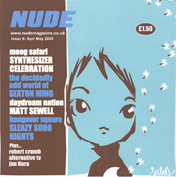
Moog
Safari |
Or how Bob Moog sparked a revolution
in pop music with his eponymous synthesizer.
Much
as you can't hold Albert Einstein to account for what happened to
Hiroshima, then you can't hold Bob Moog responsible for the horrible
misuse of his instrument by the likes of Keith Emerson and Rick Wakeman.
I have to admit that for a long time, when I was first getting into
music as a spotty teenager, I tended to associate synthesizers with
those unearthly atmospheric interludes which punctuated overblown
twenty-minute opuses about hobbits and goblins - though even in my
post-punk pomp, I had to concede that 'Silver Machine' by Hawkwind
was a pretty nifty number. But what did I know; I'd long forgotten
the simple bubblegum delight of 'Popcorn' by Hot Butter, was a bit
sniffy about seamlessly sequenced Eurodisco records such as Donna
Summer’s ‘I Feel Love’ and I hadn't even heard any
Kraftwerk whatsoever. Of course, I could say that hearing ‘Warm
Leatherette’ by The Normal changed everything for me, but that
would be a lie. In fact, it was ‘Cars’ by Gary Numan,
which more than any other record, helped open up my ears and subsequently
my heart to glorious possibilities of the synthesizer. Since then,
I've happily allowed the likes of Cabaret Voltaire, Pierre Henry,
Throbbing Gristle, the Human League, Jean Jacques Perrey, Stereolab,
Ladytron and Broadcast, to name but a few, to take me to exotic and
at times disturbing electronically created sonic terrains mercifully
free of annoying little creatures with hairy feet.
As it happens, both Emerson and Wakeman turn up in Moog, a documentary
about Bob Moog, inventor of the modern synthesiser. And credit where
it's due, though I don't care too much for his music, Wakeman always
comes across as an affable sort of geezer and is always good for a
chortlesome anecdote or two: in this case how he was given his first
Moog by a frustrated actor who just couldn't get the damn thing to
work. Turns out the foolish thesp was trying to play chords on it
when as everyone knows, the Moog is a monophonic instrument - that
is, you can only play one note at a time (well, Bob laughed!). But
then, Rick goes on to blot his copybook by engaging in Swiss Tony-style
'playing a Moog is like making love to a beautiful woman' type analogies
with jazz-funker Bernie Worrell. Cripes!
Now, despite the fact that the synthesizer and attendant electronic
music technologies have had a huge impact on all areas of music making,
you could be forgiven for thinking the shy and introverted Bob Moog,
to be a less than compelling subject for a feature-length documentary.
But you'd be wrong, because for director Hans Fjellestad, Bob Moog
embodies nothing less than 'the archetypal American maverick inventor.
The independent explorer charting new territory. The mad scientist.
The cowboy poet...'
And Fellstadt’s surprisingly engaging documentary serves as
just recognition for a great American maverick who comes across as
an endearing, eccentric, socially awkward but deeply spiritual man.
One who when not developing new types of theramin (an abiding passion),
can be seen tending his organic garden; his eyes welling-up as he
relates how his free-range chickens were recently maimed by wild dogs.
I Love my Moog by Helen Skinner
It's ‘Nothing’ Hill in the early nineties. I'm a freshly
droppped-out young-ster working in a well known chain of second hand
record/ clothes/ junk shops (job requirements — a love of Big
Star and the ability to be surly to tourists).
In my lunch hour I would frequent the music equipment branch hoping
to find something that would help me go from someone in a band (everyone
there was in one), to someone in a band with a cool thing. Then one
day there was a Moog sitting in the glass cabinet like a work of art.
Two hundred and something pounds, I'll take it! Well, I put a deposit
down and it was marked as reserved and returned to the case. I had
to wait until the next pay day until it was mine. I spent many of
my lunch hours during the rest of that month visiting the Moog, just
to looking at it and always making sure the reserved sign was still
firmly attached.
Once my Moog was safely home with me, I spent hours tinkering. I don't
think it's possible to tire of the noises it produces, and you always
discover new ones.It became a staple ingredient in my four-track noodlings,
even being immortalised in song itself by my friend Jamie and I in
‘I Love My Moog’. Sadly this classic has been lost, although
we both remember it included the line ‘it's really good, it's
got a filter contour/ Stereolab used one on tour’.
It's hard not to feel a bit smug owning a Moog: many musician types
I've chatted to have been blown away when I tell them I own a Moog
Prodigy. I've had a number of big cash offers for it, but I really
couldn't be parted from it. It's an antique, a thing of beauty, a
design classic and the most fun intsrument you'll ever play. There's
an equality to it, anyone regardless of musical knowledge can twiddle
a few knobs, press a key and… wheep,wheep,squelch,boop! And
who wouldn't enjoy that?
One important lesson I've learnt as a Moog owner is never lend it
out. I once made a two week trade of Moog for sampler. A fortnight
later I duly returned the sampler. ‘When will I get the Moog
back?’ I asked.
‘Oh, we just need it for a little longer.’ Hmmm, no less
than a year later after repeated calls and hassling, the Moog was
finally returned. I had started to worry that I'd never see it again,
but like a a kidnap victim's family being reunited with their lost
loved one, any anger immediately turned to relief as I held the Moog
tightly and promised never to let it out my sight again.
© Nude 2005 Extracted from a longer article
which appeared in issue 6 of Nude (Apr/ May 2005). |
|
 |