Lomo: Clunk Click Every Pic...
Manufactured in Russia, the LOMO LC-A is to photography what the
Trabant is to driving. Yet, it has spawned a worldwide cult known
as 'Lomography'. And as Bren O'Callaghan found, once you welcome
this low-tech camera into your heart, your life will never be quite
the same again.

The LOMO LC-A is a camera born in the thick of the cold war, developed
with covert technology and possessed of mind-altering properties.
Simply point, click and shoot from the hip.
LOMO stands for Leningradskoye Optiko Mechanichesckoye Obyedinenie
(Leningrad Optical & Mechanical Enterprise), an organisation
which tumbled forth from Mother Russia's unshaven loins back in
1914.
Its original remit was as a manufacturer of goods with military
applications for the Russian army, though it also produced cameras
for the masses. Without exception, these were serviceable-but-ridiculously
clunky objects of desire. But that all changed in 1980, when a
General Igor Petrowitsch Koritzky, got his khaki knickers in a twist
over a miniature Japanese camera -- the Kassina --- and approached
the then head of LOMO with the brief to copy and improve upon the
design.
Three years later, the first batch of 6,000 LC-A 35mm cameras were
distributed to the delegates of XXVII Congress of the Communist Party
of the Soviet Union, where they were seized upon with all of the
rabid glee of a sherry tasting in Marks & Spencers' food hall.
Indeed, one can only imagine the celebratory fun that was had, as
Boney M's Ra-Ra-Rasputin hit the turntable and someone stuck a party
hat on old Lenin himself who had been propped in the corner for the
occasion, as camera shutters clicked all around the Kremlin.
the first batch of LC-A 35mm cameras were seized upon with
all of the rabid glee of a sherry tasting in Marks & Spencers
And so, the LC-A became the camera of choice across the pan-Communist
community, from Vietnam to Cuba and back, amongst the neuter class
of East Germany, Bulgaria, Red China and Siberia's vinter vonderland.
If there was a potato queue to be found you could be sure that those
moustachioed Babushka's were vogueing for snapshots in thermal bras,
long before Reader's Wives hijacked the bear's arse aesthetic. Why,
even uncle Vanya's pot-belly at the Black Sea could now be preserved
for posterity and provide evidence for the prosecution in the case
of Male Gender versus too small Speedos.
But as the USSR wheezed its final deathrattle and trade barriers
burst, allowing in a flood of dirt-cheap, battery-powered imports
from Asia, production of the LC-A wound down with a view to halting
completely. That was until 1991, when a group of Viennese students
on holiday in Prague, stopped by a Bagpuss-stylee junk shop, purchased
a bunch of the sad black bricks and fired off reams of film which
were then developed on their return to Austria.
With its sharp glass lens, the Russian LC-A had successfully mimicked
its Japanese forbear not only in terms of looks, but also in its
unusually high light sensitivity. So, on receiving their garishly-coloured,
blurred, peculiarly atmospheric prints, the future of the LC-A was
assured. But forget Victor Kiam and his 'bought-the-company' claptrap.
This bunch of astute Austrians immediately went and secured exclusive
export rights to the camera, via a liaison with the mayor of St Petersburg
at that time, a certain Mr Vladimir Putin. With continued production
of the camera assured, they then conjured up a cunning little
marketing ruse under the moniker of The Lomographic Society. Purchase
an LC-A from them (at a price significantly higher than you would
pay in Russia), and you also get automatic membership of the global
LOMO family, a corner of the web to display your own work and a general
fuzzy feeling of belonging.

And so we come to what both appeals and repulses the owners of this
totemic, frustratingly appealing little turd. Because let's not mix
metaphors here -- the LC-A is a piece of shit. Sure, there are unique
benefits or I wouldn't be jamming my foot in your door, but remember
that no matter the self-sucking PR schlurp, this is an inferior,
poorly assembled piece of Perestroika kitsch. That said, it is still
kinda' cool.
Firstly -- appearance. Midnight black, pleasantly weighty in the
palm, finished in faux-leatherette. A sliding device beneath the
lens protects both it and the viewfinder until ready for use with
a guillotine screen. A manual wind-on mechanism and re-spooling knob
mean lots of fiddly finger action and mucho clunk-click, rat-at-at-tat
audio accompaniment akin to a satisfactory post coital sigh.
Secondly -- results. The heart of any camera is the lens, and what
makes the LOMO so special in a spastic sense is the determination
to flare its front-facing sphincter as long as is required to allow
enough light to hit the film inside.
Although known as 'automatic program exposure', this is only mechanised
at a very basic level. What rescues the LC-A from remedial relegation
is the ability to muck about and experiment with distance, shutter
speed and movement, rather than relinquish control entirely.
The LC-A is an inferior, poorly assembled piece of perestroika kitsch.
That said, it's still kinda cool
The outcome for the final print (remember kids: matt finish good -- gloss
finish naff), is that the fraction-too-long approach results in a
gaudy haemorrhage of colours, a blurring of movement, and an
indefinable sense of immediate nostalgia. The latter is largely
due to a vignetting or tunnel vision effect in which the corners
of the snap fill with shadow. It's like peering through a keyhole
or the wrong end of a telescope; a form of frame that bestows emotive
significance upon the most mundane of objects: a lost mitten; a
mouthful of toothpaste drool; a squashed spider on the sole of
a flip-flop.
Thirdly -- handicap. The LC-A is useless for portraits, tourist
snap-shots, landscapes and other credible subjects. Oh, and as for
close ups -- sorry but no can do. This ain't no replacement for more
effective photographic fare but a lo-fi accompaniment. A deliberate
embrace of the crappy and the no-frills, capturing the essence of
a mood; the moments between more legitimate events.
If after all the warnings you rather like the idea of welcoming
an LC-A into your home and heart, then be warned -- your life will
never be the same again. Bus stops will become street sculpture and
TV soaps will lose their appeal in favour of an evening hunt for
illuminated kebab menus and 'interesting blue things'. Then the screws
will start to fall out of the camera, so you have to stick it together
with duct tape. At least I did. And when the film ripped twice in
a row, I swore blind that was it. Never again! But what was the alternative -- shuffle
back into line and leave it to the experts? I think not. Photography
should be a democratic art, and by ditching perfection for moronic
tonsil-shots the censure of perceived worth holds no further hurt.
Let someone else get into a flap about it. So I tried one more time.
And there was Davey, blowing bubbles the day we got lost looking
for the water park. A pink sofa dappled with light. Someone's shoe.
Vapour trails that made a perfect triangle in the sky...
Of course it's a scam, a shrewd marketing coup re-packaged and flogged
to mugs like myself in search of a double choc-ironic fix. But all
bashed up as I am both inside and out, it suits me just fine. My
next photo project? Technicolor Pavement Pizzas, as sponsored by
the Carrot Advisory Council.
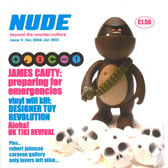
© 2003 Bren O'Callaghan. Originally published
in Nude Magazine # 1, August/ Sept 2003.
Pictures by Bren O'Callaghan.
|